
Photos to Submit for the Best Real Estate Video
- WSPR Creative
- Jun 3
- 3 min read
Updated: Jun 8
The quality of a real estate video comes down to the photos behind it. Good photos give an editor room to create smooth, dynamic camera moves that look genuinely cinematic.
The wrong photos limit what's possible or, worse, force a move that misrepresents the space.
This guide covers exactly what to shoot, what to avoid, and why, so the listing photos you already capture turn into the best possible video. It's written for real estate photographers and media companies who want video that matches the quality of their stills.
Send your highest-quality HDR photos
One of the biggest advantages of building video from photos is that the video inherits the quality of the images, including HDR. That solves a problem traditional real estate videographers fight constantly: interior shots where the windows blow out and you can't see anything outside.
With photo-to-video, a properly exposed HDR interior keeps the view out the window intact, so the finished video shows the room and the world beyond it the way the photo does. Send the same high-resolution, well-exposed photos you'd deliver to a client. The better the photo, the better the motion looks on top of it.
Shoot at an angle for the most cinematic moves


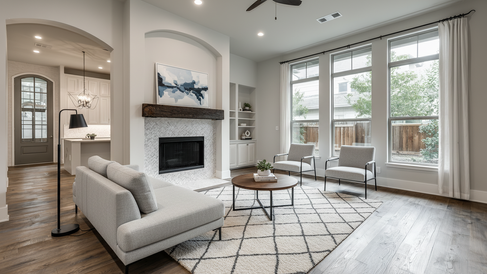
If you want the most dynamic, cinematic result, photograph rooms at an angle rather than straight on.
An angled composition gives the editor room to orbit the camera around the space, which is the kind of smooth, three-dimensional move that makes a video feel filmed rather than animated.
Straight-on photos still look great, but they're more limited. From a head-on shot, the realistic camera moves are a push in or an up-and-in move.
Both work and look clean, but they don't have the same depth as an orbit. A good rule of thumb: if a room is a selling point, give us an angled shot of it so we can move around the space.
Accuracy comes first, always
Every camera move is chosen to look good while staying true to the actual property. We won't use a move that invents space or misrepresents a room, even if it would look impressive, because accuracy to the real estate matters more than a flashy shot. Knowing this helps explain why some photos work and some don't.
The shots that cause problems, and how to fix them
The most common problem photo is one taken from a doorway looking into another room beyond. It seems useful, but it's very hard to animate honestly:
We can't move the camera backward out of the doorway, because that would create space behind the camera that doesn't exist in the photo.
We can't move the camera forward into the room either, because as the camera pushes in, it reveals more of the room than the original photo ever captured. The editor would have to invent what's there.
The fix is simple. If you want that doorway-to-room shot to work, take a second photo a few steps in. With both photos, we can connect them and move the camera forward accurately, because we actually have the information about what's on the other side.
A safe move that almost always works: the crane
When you're not sure whether a shot will animate well but want to include it, a crane move is a reliable option. The camera moves up and tilts down over the space. It's a flattering, cinematic move that stays accurate in most rooms, so it's a safe default when you want something dynamic without risk.
A quick note on which photos to send:
Think of the video as a commercial, not a catalog. Your listing photos document the home from every angle, but the video's job is to sell it, so the best results come from choosing the strongest shot from each room rather than sending everything.
Quick checklist before you submit
High-resolution, well-exposed HDR photos, the same quality you'd deliver to a client
Angled shots of the rooms you want to feature, for cinematic orbit moves
Straight-on shots are fine too, just expect a push-in or up-and-in move
For any doorway-into-another-room shot, include a second photo taken a few steps inside that room
Good coverage of the home: exterior, main living areas, kitchen, and primary spaces
Ready to get started?
Add cinematic listing video to your services without picking up a camera. Order your first video at wsprcreative.com/realestate.